Every person is different. Dementia affects people in very different ways, and abilities can change from day to day. Use these ideas as a starting point, follow the person's lead, and talk to their doctor or care team about any health concerns. Our printables are for shared enjoyment and are not a medical or therapeutic product.
Why shared activities matter
The Alzheimer's Association notes that structured and pleasant activities can often reduce agitation and improve mood, and that the type of activity and how well it's done matter less than the joy and sense of accomplishment it brings. A planned day also helps the caregiver: less time deciding what to do, more time doing something meaningful together.
Music is a good example. Research summarized by the Alzheimer's Association has found that listening to familiar music can reduce anxiety and depression and improve quality of life for some people living with dementia, although it cannot slow or prevent cognitive decline.
How to choose the right activity
- Build on lifelong interests. Activities linked to past work or hobbies feel familiar and safe: sorting mail or papers into folders for someone who worked in an office, yard work for a gardener, a recipe card for someone who loved to bake.
- Focus on what they can still do. Older skills often last longer than newer ones. Look for tasks the person starts on their own, such as setting the table, and build them into the day.
- Watch their reactions. Notice what brings a smile and what brings anxiety or irritation. Some people enjoy a lively room; others are overwhelmed by noise or a fast pace.
- Consider physical limits. Tiredness, poor eyesight, hearing loss and stiff hands all change what feels possible. Large print, good light and a comfortable chair matter. Keep an eye on safety, too: supervise sharp tools, hot surfaces and small objects, especially in the later stages, when some people may put things in their mouth.
- Pick the right time of day. Many people do best at a consistent time, often in the morning or after a rest. Late afternoon and evening can be harder for some people. If something isn't working, try again later.
- Keep groups small. One-to-one time in a quiet space is usually easier than a busy gathering.
How to help during an activity
- Start together. Show the first step yourself, then invite them to join in.
- One step at a time. Give simple, one-step instructions and focus on one task.
- Share the work. Do the difficult parts yourself and let the person do the rest. Writing, cutting and reading aloud can all be shared.
- Don't correct. Accept a different way of doing things, and let "wrong" answers be. There are no mistakes in a shared activity.
- Avoid quizzing. "Do you remember…?" can feel like a test. Try "I remember…" or put the answer into the question: "Was your first car the blue one?"
- Give it a purpose. "Let's make a card for your granddaughter" feels more meaningful than "let's color."
- Talk as you go, even if the person doesn't answer. Your voice and company are part of the activity.
Time to stop? Fidgeting, frustration, tiredness or a flat "no" are signs to pause. Never push. Stop while it's still pleasant, change to something simpler, or try again at a different time.
Activity ideas for each stage
Dementia often progresses through early, middle and late stages. These are general guides only, and stages often overlap.
Early stage
Many people still enjoy familiar hobbies and a bit of mental challenge. Ideas: easy large-print word searches, relaxed trivia played together just for fun (no scores), card and board games, cooking or baking together, writing a letter to a friend, looking through photo albums and talking about family traditions.
Middle stage
This is often the longest stage. Activities work best when they are shorter, simpler and done side by side. Ideas: looking at a picture of an everyday object and talking about it, choosing between two words or pictures, sorting or folding laundry, conversation cards with gentle questions, singing favorite songs, a short walk.
Late stage
The focus shifts to comfort and the senses. Ideas: listening to music from their younger years, a gentle hand massage with lotion, looking at a photo book or a book of large pictures together, holding a soft blanket, sitting outside in the sun. Your presence and a warm tone of voice are the activity.
A sample 20-minute session
- Settle in (2 minutes). Sit side by side in a quiet, well-lit spot. Turn off the TV, and make sure glasses and hearing aids are in.
- Look and talk (8 minutes). Open a page with a familiar picture, such as a teapot. Ask one easy, open question: "What do you think of this one?" or "Tell me about teapots like this." Listen, and share a memory of your own.
- A simple choice (5 minutes). "Tea or coffee?" "Which of these two flowers do you like?" Choices with two options are easy and feel good to answer.
- A song to finish (5 minutes). Play or hum a song from their teens or twenties.
- End on a high note. Thank them for the time together, even if the page isn't finished.
Adapting for eyesight and hearing
- Use large print with strong contrast, such as dark letters on a light page, and good, glare-free light.
- Choose one activity per page so the eye has only one thing to focus on.
- Sit facing the person or side by side, speak slowly and clearly, and keep background noise low.
- Have eyes and ears checked regularly. Vision and hearing problems can make communication harder and are often treatable.
Large-print printables made for sharing
We designed these with the principles above in mind: large print, one calm activity per page, familiar everyday pictures, and no timers or scores. Writing is always optional, and a care partner can point, read or write while the person chooses.
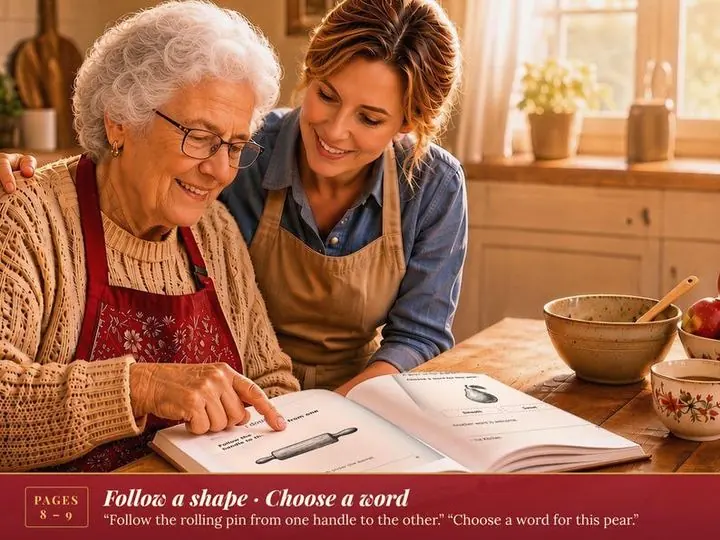
Everyday Moments Together
Five large-print books of gentle one-page activities: In the Kitchen, In the Garden, Out and About, Music We Love and Making Things, with a companion page of simple tips.
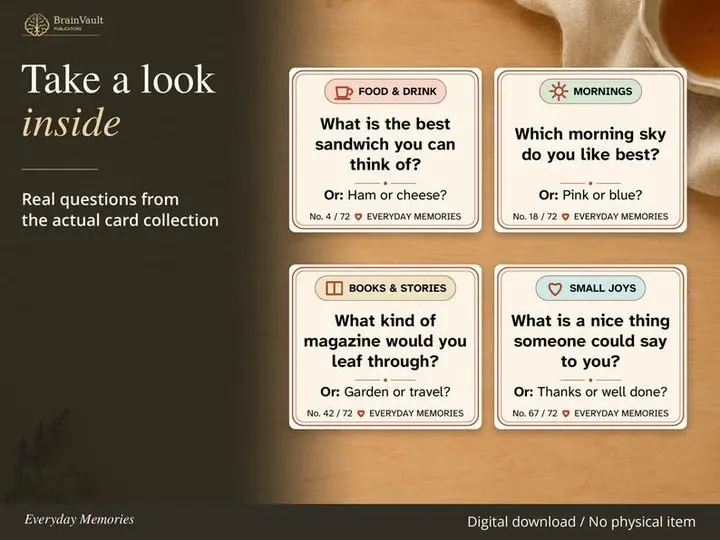
Conversation Cards for Seniors
Large-print cards with gentle questions that invite stories and memories. Five themed decks of 72 cards each, 360 prompts in all, in US Letter and A4.
Prefer a printed book? Our Golden Years large-print word search is available as a paperback on Amazon.
Take care of yourself too
Caring for someone with dementia is demanding, and your own rest matters. Short breaks, help from family and friends, and a caregiver support group can make a real difference. In the US, the Alzheimer's Association offers a free 24/7 Helpline at 800-272-3900, and the National Institute on Aging publishes free caregiving guides at nia.nih.gov.
Sources
- Alzheimer's Association: Activities, Daily Care Plan, Communication, Stages of Alzheimer's, Playing the Mind's Soundtrack
- Alzheimer's Foundation of America: Therapeutic Activities for 3 Main Stages of Alzheimer's Disease
- National Institute on Aging: Adapting Activities for People With Alzheimer's Disease
Questions families ask
What activities are good for seniors living with dementia?
Short, familiar and calm activities usually work best: looking at pictures and talking about them, conversation cards, familiar music, simple sorting or matching, and easy large-print puzzles. Choose topics connected to the person's life and interests, and adapt as their abilities change.
How long should an activity last?
Often 10 to 20 minutes is enough, especially in the middle and late stages, and in the late stage 5 to 10 minutes may be plenty. Watch for tiredness or frustration and stop while it is still enjoyable.
What if they can't answer or get it wrong?
That's fine. There are no wrong answers in a shared activity. Gently move on, share your own answer, offer two choices, or simply enjoy the picture together.
What if they refuse to take part?
Don't force it. Refusal can mean the task feels too hard, the timing is wrong or they are tired. Try again later, simplify the activity, or invite them to watch while you do it.
Are word searches good for people with dementia?
For some people, especially in the early stage, an easy large-print word search with familiar words is relaxing and enjoyable. Later on, picture-based activities and conversation often work better.
Are these printables a treatment for dementia?
No. BrainVault activity books and cards are for shared enjoyment and conversation. They are not a medical or therapeutic product and don't replace advice from a doctor.
What size is the print?
Large. In the Kitchen (Vol. 1), for example, uses 16-point letters or larger on every page, with one activity per page.