Your planning checklist
Two weeks before
- Meet the teacher. Confirm the start and end time, how long the party can run, and the school's rules on food, treats and decorations.
- Agree on a card rule. Many teachers use an "everyone or no one" policy: if a child brings cards, they bring one for every classmate. It is the simplest way to make sure nobody is left out.
- Confirm the date with the teacher. In 2027, Valentine's Day falls on a Sunday and Monday, February 15, is Presidents' Day, so many schools will hold class parties on Friday, February 12.
- Send home a class list. With the teacher's OK, share every child's first name (and any classroom aides the class wants to include), so families know exactly how many cards to prepare.
- Line up helpers. A party with 20+ kids runs best with three or four adults, each with one clear job.
The week before
- Choose two games and one backup. See the schedule and grade guide below.
- Print everything. Bingo cards last longer on card stock. Slip them into sheet protectors if you want to use dry-erase markers and reuse them.
- Gather markers and prizes. Paper hearts, crayons or bingo daubers work as markers. With younger children, skip small items like buttons that could be a choking risk. Stickers, pencils and bookmarks make good prizes.
- Prepare a quiet option for any child who does not celebrate Valentine's Day or needs a break, such as a reading corner or a puzzle sheet.
The day before and on the day
- Sort printables into one folder per game, and hand each helper their folder and a copy of the schedule.
- If you are running a scavenger hunt, hide the clues at kid height and walk the route once before the kids arrive.
- Ask one adult to take photos, following the school's photo policy. Some families opt out, and many schools ask that class photos stay off social media. Keep phones on silent.
A 45-minute party schedule
Most class parties land in the last hour of the school day. This plan keeps everyone busy, gives each adult a clear job, and ends on time.
- Card delivery (10 minutes). One table at a time, kids drop their cards into each other's bags or boxes while quiet music plays.
- Picture bingo (15 minutes). The whole class plays at once, and children who are still learning to read can follow along because every square has a picture and its name. Two or three short rounds are plenty.
- Pass the Valentine (10 minutes). Everyone sits in a circle with one small prize. An adult reads a short story aloud, and the prize is passed to the left or right each time the story says so. Whoever holds it at the end keeps it, and then everyone picks a small treat from the extras basket.
- Snack, if your school allows food, and card reading (10 minutes). A calm finish: kids open their cards while they eat.
Big class or plenty of helpers? Try stations instead. Split the class into three groups and rotate every 10 minutes between bingo, a simple card-decorating table and a scavenger hunt. The 30 minutes of stations replace bingo and the left-right game. Each helper stays at one station, and the hunt helper re-hides the clues between groups.
Which games work for which grade
Preschool and kindergarten (ages 3–6)
Keep games short and visual. Picture bingo works well with an adult calling slowly and holding up each calling card. In a scavenger hunt, use picture clue cards: children look at the picture and walk to the matching spot, no reading needed. Kindergartners who are starting to read can use either the picture cards or the rhyming riddles. Expect attention for 10 to 15 minutes per game.
Grades 1–2 (ages 6–8)
Children this age love bingo with a twist. After a regular five-in-a-row round, try "four corners." Blackout rounds take longer, so save one for the end. Pass-the-prize story games are a hit because everyone plays at once and listens for the next LEFT or RIGHT.
Grades 3–5 (ages 8–11)
Older kids want a challenge. Use the rhyming riddle cards for a scavenger hunt in teams of three or four, or let a student take a turn as the bingo caller. Keep prizes small so the focus stays on the fun.
Make it a good day for every child
- Cards for everyone. The class list and the "everyone or no one" rule prevent hurt feelings before they start. Keep a few spare blank cards so a child who forgot can still take part.
- Allergy-aware choices. Food allergies are common, and some can be serious. Follow your school's food policy, and consider non-food extras: stickers, pencils, erasers and bookmarks work for everyone. Use non-food bingo markers too, and ask families to skip candy or food taped to cards unless the school allows it.
- Families who don't celebrate. Offer a neutral activity, such as a puzzle or reading corner, so every child has something to enjoy.
- Kids who find parties overwhelming. A quiet corner and a calm, predictable schedule help. Tell the class what is coming next before each activity.
- Prizes for all. Keep a small basket of extras so nobody goes home empty-handed.
Low-prep printable Valentine games
Each game is a printable PDF you download right away. Print what you need on regular paper or card stock. Nothing is shipped.
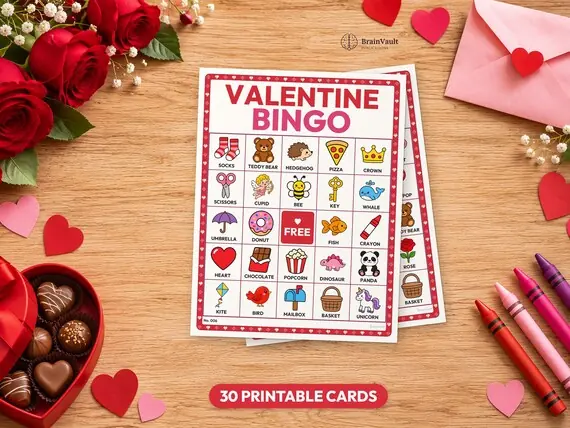
Valentine Picture Bingo
Each card has 24 labeled pictures plus a FREE space. Includes calling cards, a caller's sheet and six ways to play. Choose 30, 50 or 100 cards.
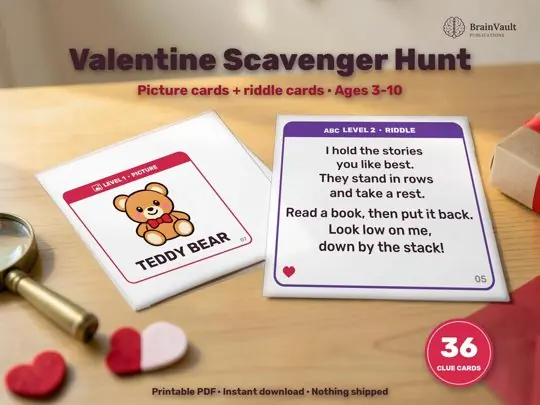
Valentine Scavenger Hunt
36 clue cards: picture cards for ages 3–5 and rhyming riddles for ages 6–10, plus prize coupons.
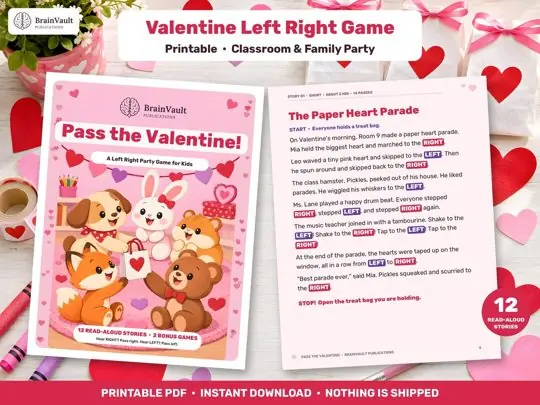
Pass the Valentine! Left Right Game
12 read-aloud stories and 2 bonus games. Pass the prize on every LEFT and RIGHT.
How many bingo cards do you need?
Plan on one card per child. The 30-card set covers most classes. Choose 50 or 100 cards for a bigger group, several classes, or if you want to hand out fresh cards each round.
Supply list
- Printed games, sorted into one folder per game
- Card stock or sheet protectors for bingo cards
- Bingo markers: paper hearts, crayons or bingo daubers
- One small prize for the left-right game, plus a basket of extras
- Painter's tape for hiding scavenger hunt clues (it won't damage walls)
- Dry-erase markers, if you use sheet protectors
- A speaker or device for quiet music
- For stations: blank cards, crayons and stickers for the decorating table
- Bags or boxes for cards, and wipes or napkins for snack time
Questions teachers and parents ask
What are easy Valentine's games for a classroom party?
Picture bingo and a left-right story game are the easiest, because the whole class plays at once and one adult runs each game. A scavenger hunt is a great extra if you have more time or helpers.
How long should a Valentine's class party be?
Most class parties run 45 minutes to an hour. Plan card delivery, two games and a snack, and keep one short game in reserve.
How do I make sure no child is left out?
Send home a class list and ask families to bring a card for every classmate or none at all. Keep a basket of extra prizes and offer a neutral activity for any child who doesn't celebrate.
What can we use instead of candy?
Stickers, pencils, erasers and bookmarks are popular non-food options, and paper hearts or crayons work as bingo markers. Always follow your school's food policy.
What age are these Valentine printables for?
The scavenger hunt has picture cards for ages 3–5 and riddles for ages 6–10. Picture bingo and the left-right game work from preschool through elementary school with an adult running the game.
Will anything be mailed to me?
No. These Valentine games are instant PDF downloads. You print as many copies as you need for your own class or family.
Can I print on A4 paper?
Yes. All three Valentine games include both US Letter and A4 files.