Why a good question matters
As people age, they often spend more time alone. The National Institute on Aging notes that loneliness and social isolation are linked to a higher risk of health problems, and that everyone needs social connection to thrive. A real conversation, the kind where someone is curious about your life, is one of the simplest ways to connect.
Talking about the past has a name in care settings: reminiscence. A Cochrane review found that reminiscence may slightly help communication, mood and, in care homes, quality of life for people living with dementia, but the effects were small and inconsistent. For most families, the bigger reward is simpler: you learn who your loved one was before you knew them.
Tips for easier conversations
- Ask open questions, with an easy fallback. "What was your first job like?" invites a story. If the answer doesn't come, offer two choices: "Was it indoors or outdoors?"
- Skip the quiz. "Do you remember…?" can feel like a test. Try "Tell me about…" or "I've always wondered…" instead.
- Let silence work. Pause and give the person time to gather their thoughts. You don't need to fill every gap.
- Make it easy to hear. Sit face to face in good light, turn off the TV, and speak clearly without shouting.
- Share a little of your own. Conversation is a two-way street. Your story often prompts theirs.
- Follow the energy. If a question lands, ask a follow-up. If it doesn't, move on lightly. Some topics bring up sad memories; it's fine to acknowledge that and change the subject gently.
- Go gently with big topics. Politics, religion, money, health, war or the loss of a spouse can be painful. Let the person lead if they bring them up.
- On the phone or a video call, keep background noise down, speak a little slower, and turn on captions if the app offers them. A shared photo or song works on calls too.
- Check the basics. If the person uses hearing aids or glasses, make sure they're in and working before you start.
- Use what's around you. Photos, a favorite song, a recipe card or an old object can spark more than any question.
If your loved one is living with dementia, see our guide to gentle activities for seniors living with dementia for more communication tips.
48 conversation starters
A few quick either/or questions are mixed in as easy warm-ups. Want them on paper? Download the free large-print list.
Growing up
- What did the house you grew up in look like?
- What games did you play outside with friends?
- Who was your best friend as a child, and what did you get up to?
- What was a typical Sunday like in your family?
- Was there a teacher you've never forgotten?
- What chores did you have as a kid?
- What did you want to be when you grew up?
- What's a smell that takes you straight back to childhood?
Food and kitchen
- What was your favorite meal growing up?
- Who was the best cook in your family?
- Is there a recipe you've made for years?
- What was a special treat when you were young?
- Do you prefer cooking or baking?
- What's the best restaurant meal you can remember?
- What did holiday dinners look like at your house?
- Sweet or savory breakfast?
Work and skills
- What was your very first job?
- What work have you been proudest of?
- Who taught you something important at work?
- What's a skill you have that most people don't?
- What tools or gadgets did you use every day?
- Was there a time something went hilariously wrong at work?
- If you could have tried any other job, what would it be?
- What advice would you give someone starting their first job?
Music, movies and fun
- What song always gets you tapping your feet?
- Who was your favorite singer or band when you were young?
- What's the first movie you remember seeing in a theater?
- Did you like to dance? Where did people go dancing?
- What radio or TV shows did your family enjoy together?
- What was the best concert or show you ever saw?
- Which song would you play at a party today?
- Were you more of a movie person or a music person?
Places and travel
- What's the most beautiful place you've ever been?
- Did your family take trips when you were young? Where did you go?
- What was your neighborhood like when you were young?
- Is there a place you'd love to visit again?
- Beach or mountains?
- Did you have a first car or bike you loved? Where did it take you?
- What's a place that feels like home to you?
- If you could take a trip anywhere tomorrow, where would you go?
Traditions and life lessons
- What's a family tradition you loved?
- How did your family celebrate birthdays?
- What's the best advice anyone ever gave you?
- What are you most grateful for?
- What's something that's changed for the better since you were young?
- What makes a good friend?
- What's a small thing that always makes your day?
- What would you like the younger people in your family to know about your life?
Make it a keepsake. With permission, jot down a few answers or record a short voice memo. Years from now, those stories are treasures.
Using conversation starters in groups and care homes
- Pick one theme per session, such as music or school days, so stories build on each other.
- Read the question aloud and let people answer in turn, with no pressure to speak. Passing is always fine.
- Keep groups small, around four to eight people, so everyone can hear and be heard.
- Mix in an object or a song that matches the theme, like a vintage photo or a record.
- Plan for 20 to 30 minutes, and end on a light, happy question.
Printable conversation cards
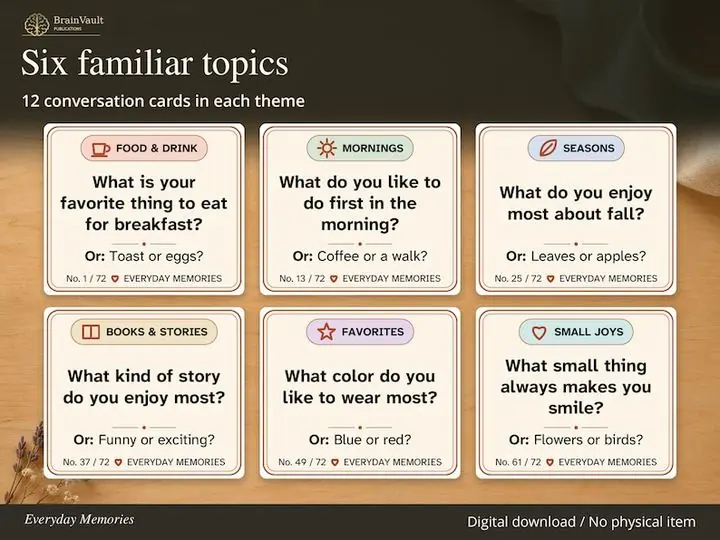
Our printable cards make conversation easy to start: each card has one open question in large, bold print, plus an easier "Or:" line with two simple choices. Every question is optional, and a companion can read the card aloud.
Conversation Cards, 5-Deck Bundle
360 cards in five themed decks: Everyday Memories, Childhood & Home, Work & Hobbies, Holidays & Traditions, and Music & Movies. 22-point questions, six cards per page, in US Letter and A4. Each deck also includes a question list for group leaders and blank cards for your own questions.
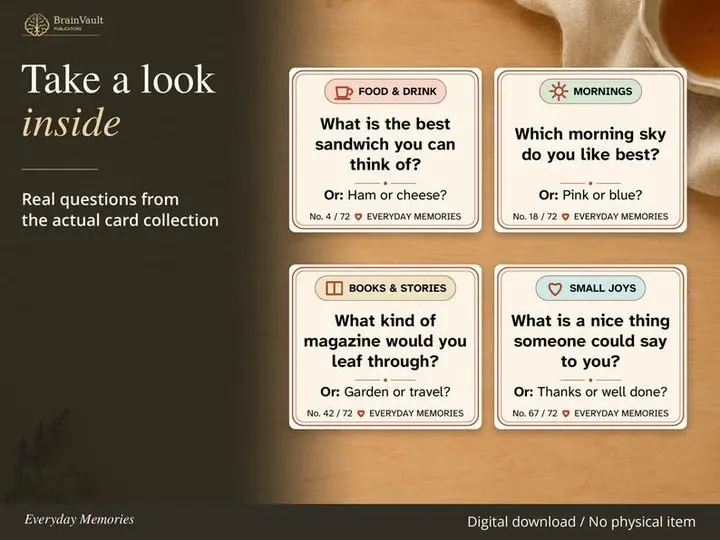
Deck 1: Everyday Memories
Start with one deck: 72 cards on food and drink, mornings, seasons, books, favorites and small joys.
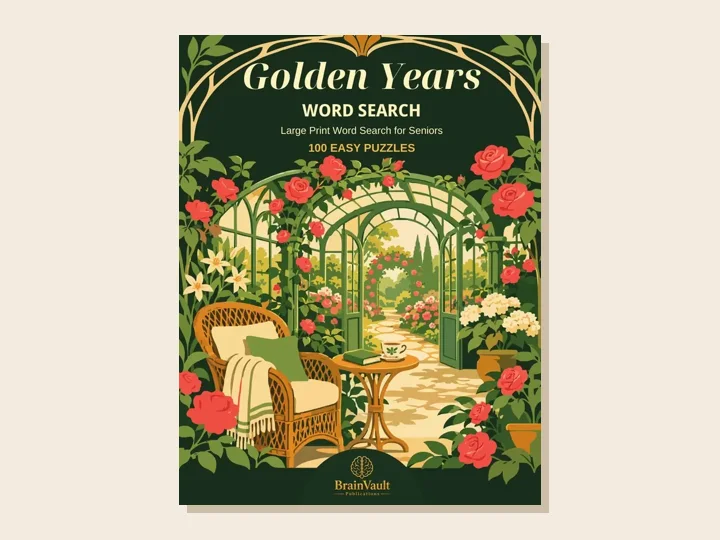
Golden Years
A gentle activity to share on a visit: 100 easy large-print word searches with nostalgic themes, printed and shipped by Amazon.
Sources
- National Institute on Aging: Loneliness and Social Isolation: Tips for Staying Connected
- Cochrane: Reminiscence therapy for dementia (Woods et al., 2018)
- Independent Age: Starting a conversation
This guide is general information, not medical or mental health advice. If you're worried about someone's mood or loneliness, encourage them to talk with their doctor.
Common questions
What are good conversation starters for seniors?
Open questions about everyday life work best: childhood homes, first jobs, favorite songs, family recipes and places they've loved. Add an easy either/or option if an answer doesn't come.
How do I talk to an elderly parent who doesn't say much?
Sit face to face in a quiet spot, ask one open question, and give plenty of time to answer. Photos, music or a familiar object can help, and sharing a story of your own often opens the door.
What questions should I avoid?
Avoid quizzing ("Do you remember…?"), correcting details, or pressing on topics that seem painful. If a question brings up sadness, acknowledge it kindly and move on.
Can conversation cards be used with people living with dementia?
Yes, with care. Choose simple questions, offer two choices when needed, and treat every answer as the right one. The goal is a pleasant moment, not accurate facts.
How many people can use the cards at once?
They work one-to-one or in small groups. In a care home or senior center, the group leader can read the questions aloud from the included list.
Will anything be mailed to me?
Our conversation cards are instant PDF downloads you print and cut out. Our paperback puzzle books are printed and shipped by Amazon.